
Starting a Norwich Township Resident Search
Norwich Township does not have one public list that proves every household. Its useful records are held by Franklin County and, depending on the parcel, by a Township or municipal office. Start with the Franklin County Auditor when an address or possible owner is known. Use the Recorder when the question is about a recorded land transfer. For a historic household, compare a city directory with a deed and a released census. Each source identifies a different relationship to the address.
An owner field is a property-record fact, a deed names recorded parties, and a directory can place an occupant at an address in one edition year. None alone supplies a household list. Court, Probate, voter self-service, and state records can offer narrower confirmation paths, subject to their own limits.
- Search the address in the Auditor Property Search and record the parcel ID and situs.
- Use the Parcel Viewer to check mapped location and jurisdiction clues.
- Use the legal description and current transfer to search the Recorder.
- Compare a past address with a directory edition and released census.
- Ask the actual custodian for a specific existing record when the online route ends.
Norwich Township Resident Record Offices
Franklin County is the practical records hub for Norwich Township. The Recorder maintains recorded land documents. The Auditor maintains the parcel and real-property inventory. The Board of Elections handles local registration questions. Norwich Township keeps its own operational public records. These offices are useful because their records have defined custodians and access channels, not because any one office maintains a universal residents directory.
Franklin County Recorder
373 S. High St., 18th Floor
Columbus, OH 43215
614-525-3930
Franklin County Auditor
Real-property inventory and parcel research
Franklin County, Ohio
614-525-HOME (4663)
Norwich Township Parcel Record Routes
The Auditor Property Search is the current-address entrance to the Norwich Township residents directory. Its navigation includes Owner Name, Address, Parcel ID, Subdivision & Condo, Advanced Search, Map Search, and Intersection Search. Owner searching can match a name anywhere in an owner list. Address searching includes parcel and building addresses. A partial parcel search can return many results, so a result should be checked against its situs and parcel information before it is tied to a person.
| Property Search control | Useful record question |
|---|---|
| Owner Name | Whether a name appears in an owner record. |
| Address | Which parcel or building record matches an address. |
| Parcel ID | The stable property key, entered without dashes. |
| Subdivision & Condo | A named development route. |
| Map and Intersection | Geographic routes for narrowing a property question. |
The official Auditor search is shown in this Norwich Township residents directory image.
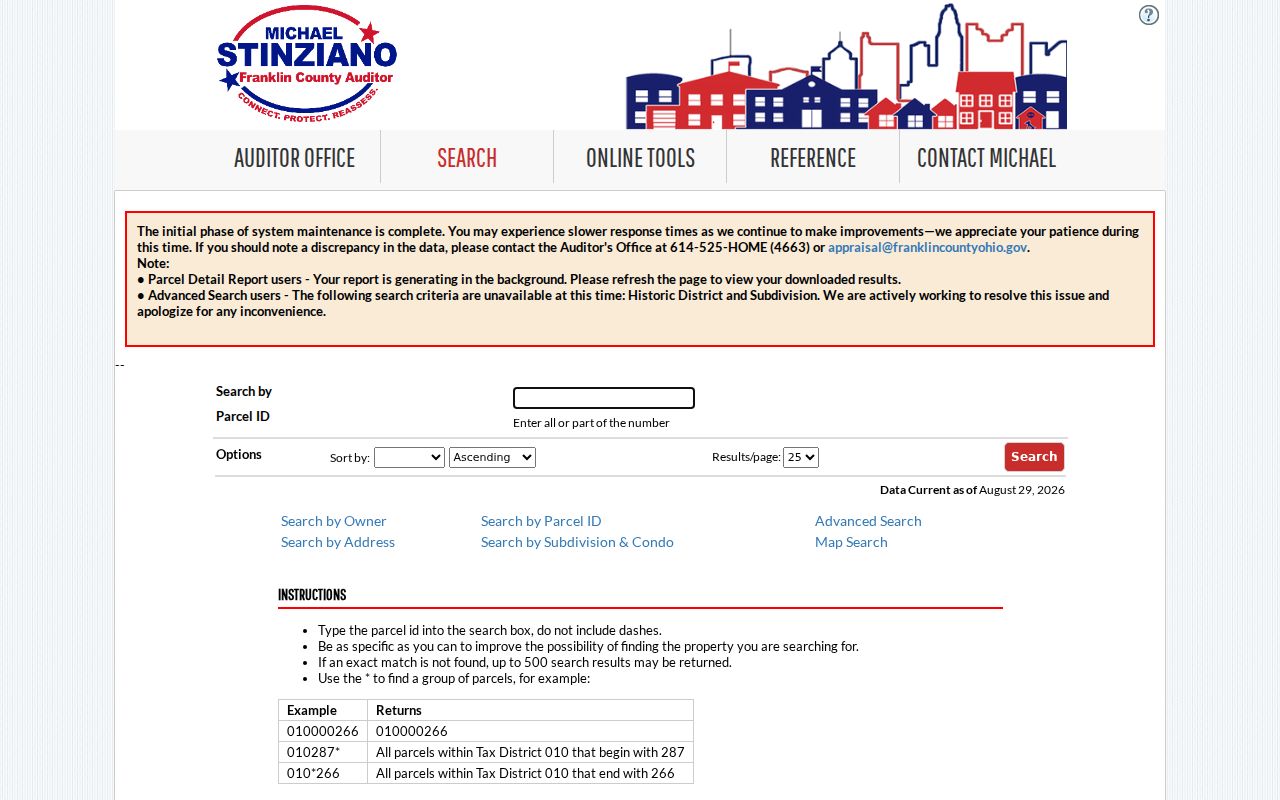
The screen begins a property-record question. It does not establish every person who may live at the situs.
Norwich Township Deed Trail
The Franklin County Recorder offers cloud and legacy public-search routes, with registration optional to begin. A deed search should confirm grantor, grantee, document date, instrument or book and page, and legal description. That description matters because an older deed can identify a lot, subdivision, acreage, or predecessor parcel rather than a modern street number.
The deed index begins January 2, 1914. Named historic index paths cover 1804 through 1913. Follow the current grantee to the acquisition document, then search that seller as an earlier grantee. This is more reliable than treating a text match on an old street name as proof of a title chain.
The Recorder public-search page is shown in this image.
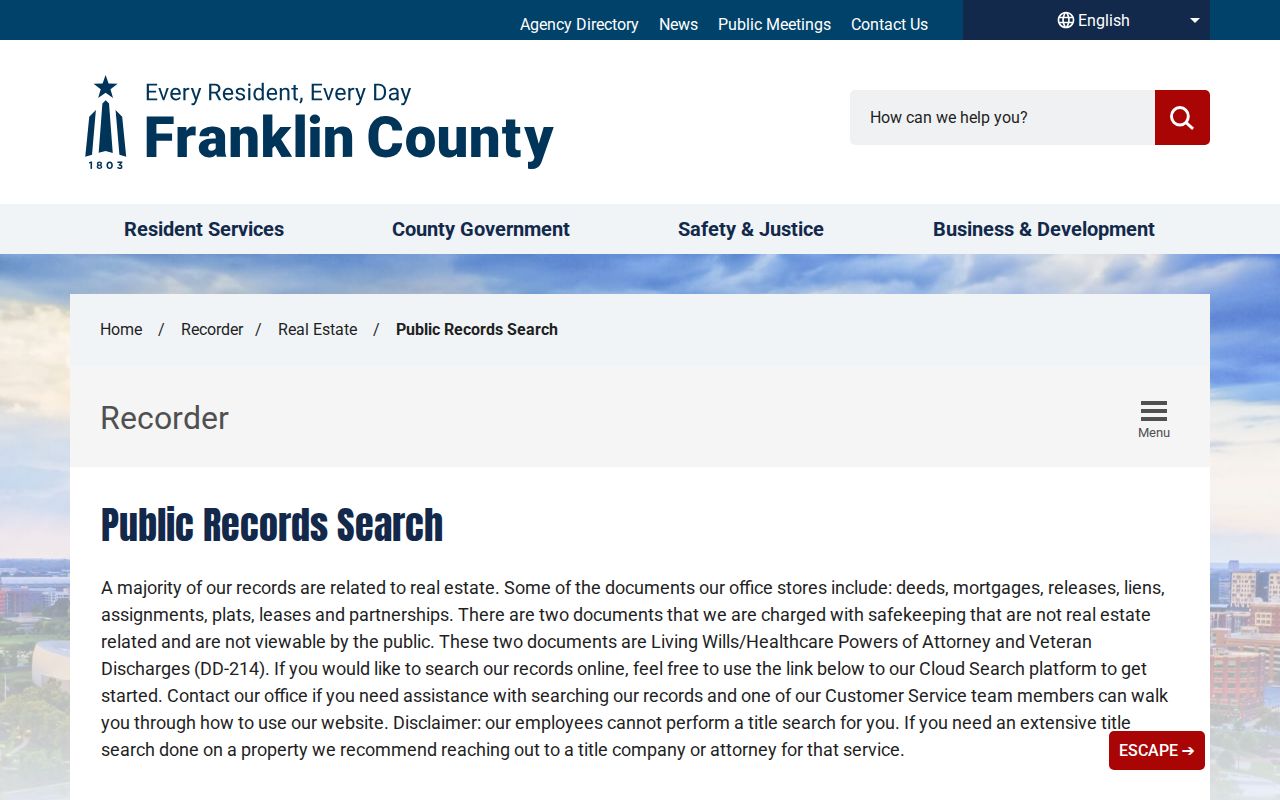
When the index stops, the Recorder counter, phone, email, and a targeted request for an existing record remain research channels.
Current Norwich Township Resident Records
Current records are narrow, verifiable sources, not interchangeable directories. Property records identify a parcel and owner record. The voter tool helps one individual check registration and precinct information. Court and Probate systems can establish a public docket or historical court record, but they do not confirm that a person currently lives at an address.
| Source | What it records | Custodian | Access route |
|---|---|---|---|
| Auditor Property Search | Parcel, situs, owner and transfer context | Franklin County Auditor | Public search and discrepancy contact |
| Recorded-document index | Grantor, grantee, instrument, legal description | Franklin County Recorder | Cloud, legacy, counter, historic indexes |
| My Voter Information | Individual registration, precinct and polling help | Ohio Secretary of State | Name plus Franklin County |
| Case Information Online | Public docket information | Franklin County Clerk | Name/case search and official-file fallback |
Ohio My Voter Information requires first name, last name, and county. It is an individual registration and precinct check, not a browseable street roster.
Norwich Township Court Record Checks
Franklin County Clerk Case Information Online, known as CIO, covers public docket information for Common Pleas General Division civil and criminal matters, Domestic Relations, and the Tenth District Court of Appeals. Municipal Court is separate. Federal matters use PACER for the Southern District of Ohio.
CIO offers name, court, party role, attorney number, filed-date, and case-number fields. A result supplies party, court, case, filing, and docket context. The Clerk says the online material is a copy and the original courthouse file controls. Use the counter, clerk copy route, or a specific Ohio Public Records Act request when an official document or a question about redactions is needed.
Franklin County CIO is shown in this image.
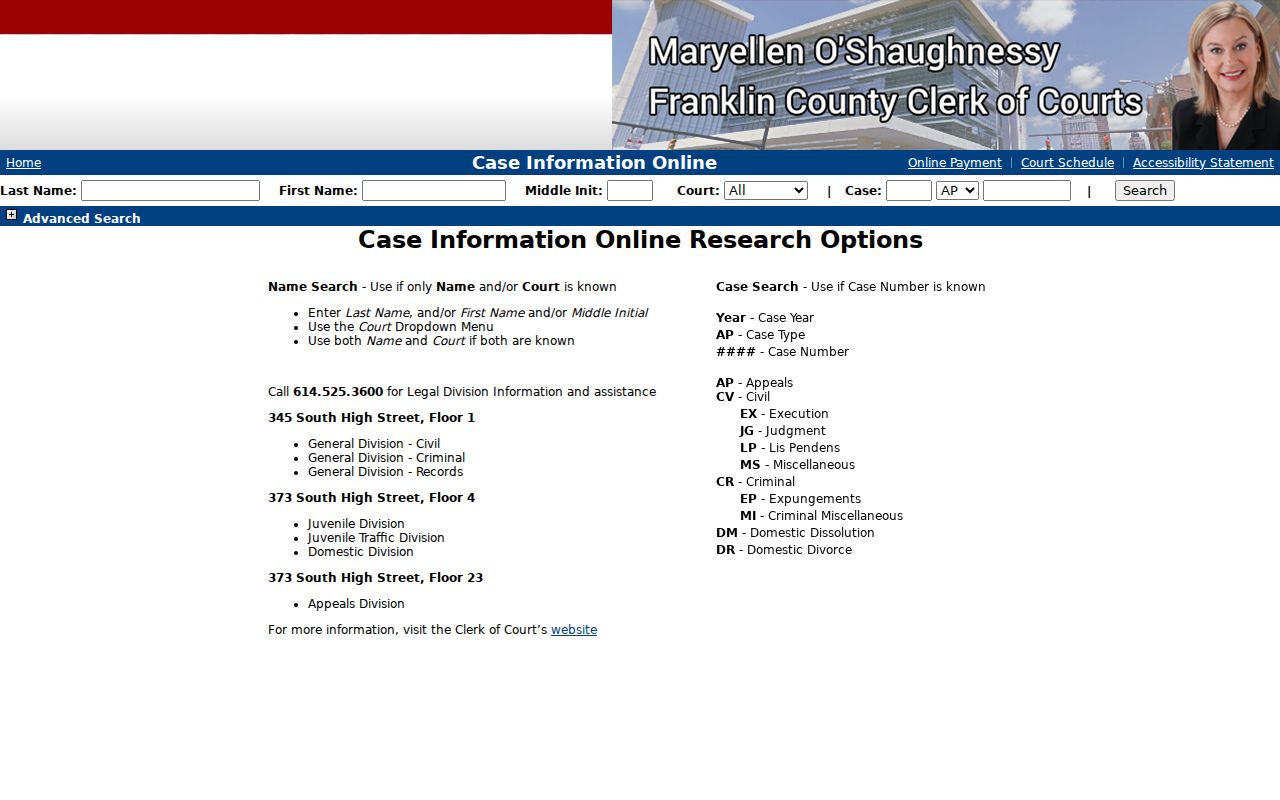
A same-name docket hit needs independent confirmation from court, date, party role, or another official record.
Norwich Township Public Request Path
Ohio Public Records Act, ORC 149.43, covers records held by Ohio public offices unless an exemption applies. Inspection should be available promptly and copies within a reasonable period. An office may ask for a written request, identity, or intended use only after explaining that those details are optional and why they would help identify, locate, or deliver the record.
A focused request works better than asking an office to build a person list. Name the custodian, existing record type, precise address, parcel, case, document number, name as indexed, or limited date range. Ask whether inspection or a copy is wanted.
Norwich Township Postal Geography
Norwich Township is not one simple postal or municipal identity. Four ZIP codes were confirmed in county parcel records: 43016, 43026, 43221, and 43228. They cross Hilliard, Columbus, unincorporated, and differing mailing-city contexts. Postal routing, municipal boundary, tax district, and legal land identity should be checked separately.
The current Engineer map reports a 2.50-square-mile operational Township footprint, 13.563 Township-controlled road miles, and a MORPC 2024 population estimate of 3,699. Census county-subdivision geography called Norwich Township is larger. Those are distinct measures, not figures to combine.
USPS ZIP Lookup verifies a delivery ZIP for an exact address.
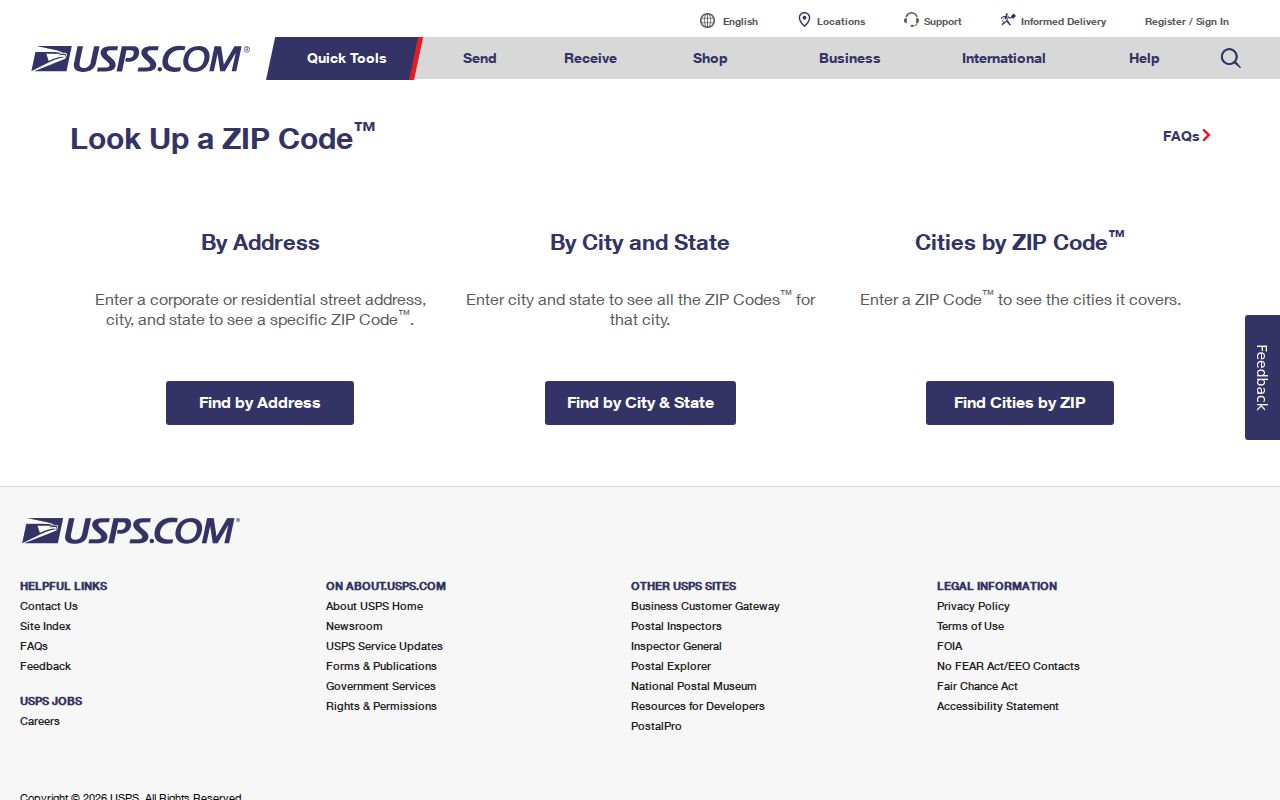
USPS warns that a ZIP result does not verify that a named person or company is at the address.
Norwich Township Library Directory Evidence
Columbus Metropolitan Library Local History & Genealogy is the historic shelf behind this Norwich Township residents directory. The Main Library holds Columbus city directories back to 1841. Starting in 1911, the series includes a section arranged by street address. The digitized City Directory Collection is still growing and includes early Franklin County telephone directories, but a missing online year does not mean the physical collection or staff research route has ended.
A directory entry can place a listed person or household at an address for that edition year and often gives an occupation. It does not establish ownership. Compare it with the parcel and recorded-deed trail, then pair it with the closest released federal census. The collection and household tracing method are developed in the Norwich Township Directory Book.
The Library house-history guidance is pictured here.
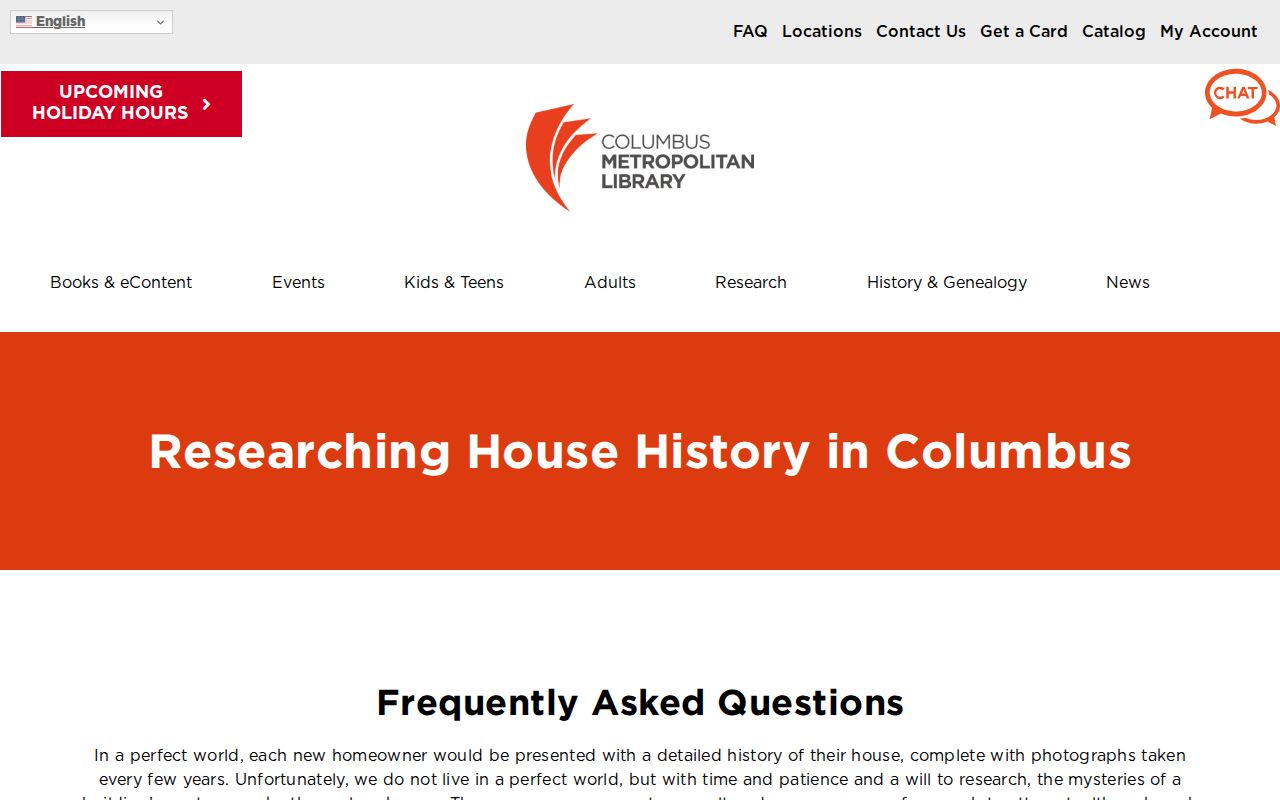
The guide joins Auditor records, directories, and historic maps while warning that some pre-1920 year-built entries are guesses.
Historical Norwich Township Resident Directories
Historical research needs several time layers. Library directories begin in 1841 and the street section starts in 1911. The Recorder uses historic indexes for 1804 through 1913, and released federal census records currently reach 1950. Hilliard Historical Society family files, maps, newspapers, and local history resources offer another area channel, but each lead needs comparison with an official or time-matched record.
Some Franklin County early records were destroyed in the 1879 fire, yet most were reconstructed. Compare historic Recorder indexes, document images, Probate records, tax or plat material, directories, and newspapers. It is not correct to assume all early documentation disappeared or that every index is complete.
Wesley Chapel Cemetery provides a local genealogy route.
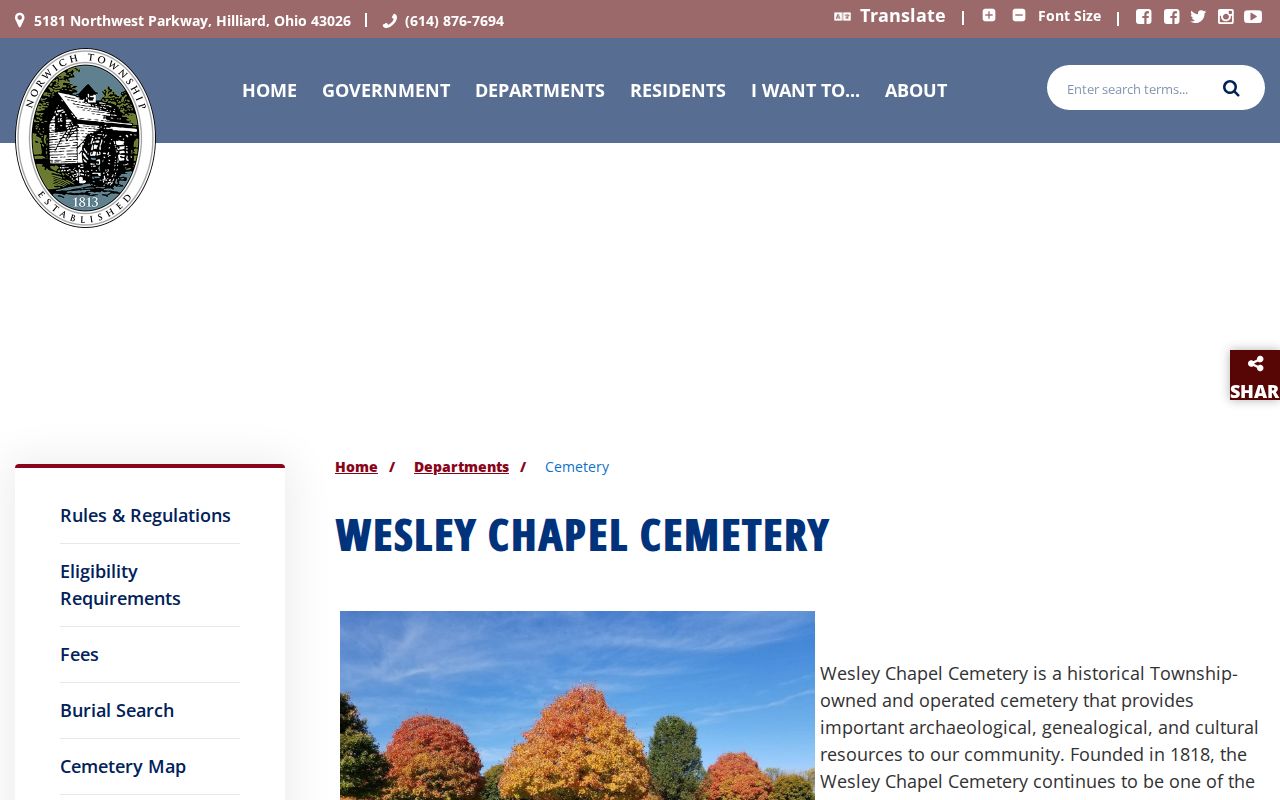
The linked burial search offers name, date, and location-oriented fields, but no published coverage range supports a completeness claim.
Norwich Township Records and Privacy
Record absence does not prove a person was never at a place. Ohio Safe at Home can protect a qualifying participant’s substitute address in voting and official correspondence. Voter, court, vital, and property records can contain fields that are confidential or lawfully redacted. A property owner, recorded party, voter lookup result, and directory occupant are four separate facts, and none is a household roster.
Norwich Township offers a concrete public-records fallback for its own existing operational material. Its policy identifies Administrator Jamie Fisher as public-records contact, lists normal hours of Monday through Friday 8 to 4, and says emailed records are free. County property, court, Recorder, and election material belongs with the relevant custodian.
Norwich Township public records appears in this image.
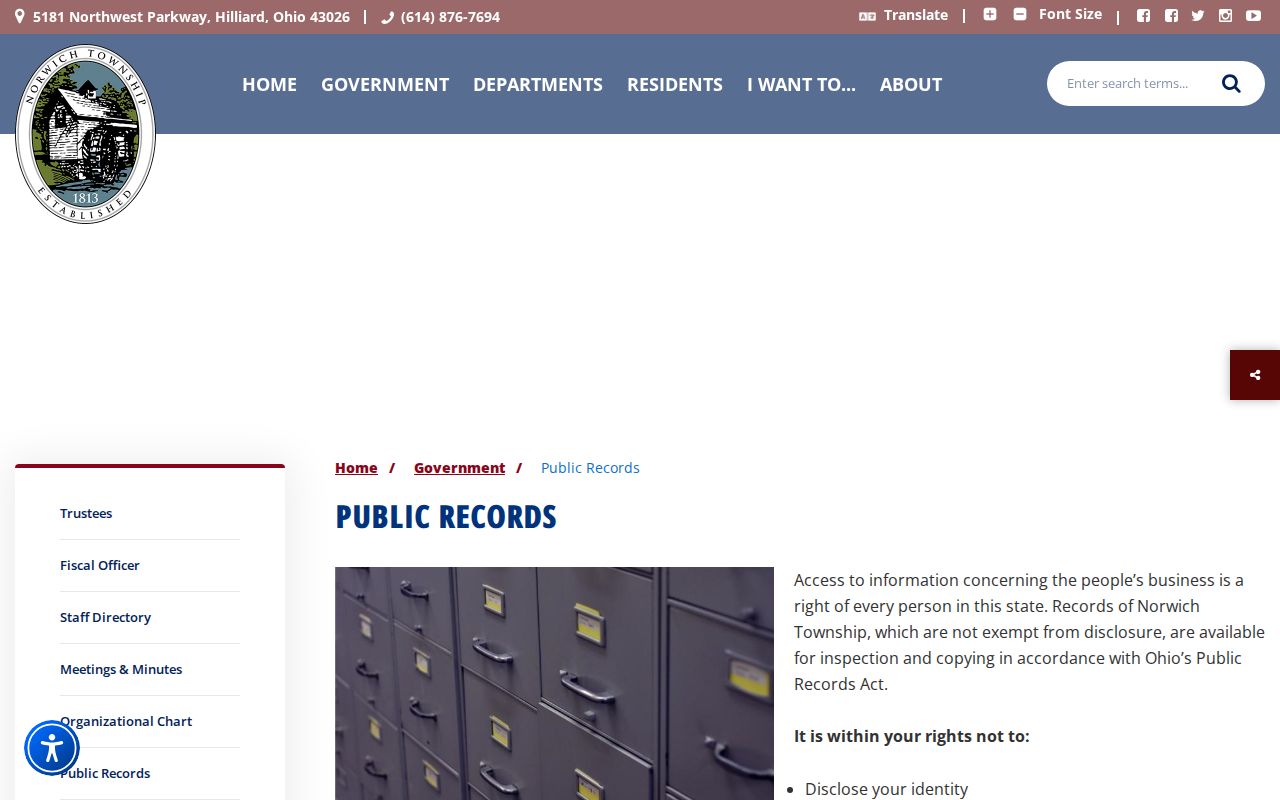
Using a designated office and narrow request respects both custody and privacy boundaries.
Norwich Township Property Update Context
The Recorder’s 2025 Document Imaging Center report describes millions of converted records and indexed images. Digitization can improve access while confidentiality rules still control restricted files. Franklin County also migrated agency web pages in 2025, so a historical deep link can move even when a service remains active. Start from the current agency landing page when a saved link fails.
Auditor notices in 2026 describe property-value updates and review options. Those announcements concern assessed-value information, not title or household identity. Verify the document, parcel, and date with the respective custodian rather than reading an assessment update as proof of who lives there.
The Parcel Viewer is shown in this additional image.
The Viewer is strongest when it identifies one parcel and links to the matching property record for verification.
Norwich Township Probate Record Routes
Franklin County Probate Court provides a family-history channel that complements, but does not replace, parcel and directory research. The Court reports marriage records from 1803 to the present, estate, guardianship, and name-change records from 1898 to the present, and county birth and death holdings for 1867 through 1908. Depending on age, a file can be an original paper record, microfilm, microfiche, or an electronic image. Probate material can help explain a surname change, an estate relationship, or a historical event after an address or directory lead has been established.
A Franklin County certified marriage abstract has a specific path. First search the Marriage License Index and confirm that the license was issued in Franklin County and that a “Certif Returned” date appears. If that date is absent, the Court directs the requester to contact the officiant rather than assume an abstract is ready. The Court offers online, mail, and in-person ordering. Its published charge is $2 per certified abstract, with stated online transaction and postage costs where applicable. A request should identify both applicants and an approximate year, not rely on a loose surname match.
The Probate Court certified-records route is also an alternative when a historical document is not in a current web index. Confidential categories, including adoption and certain mental-health or developmental-disabilities records, are not open for public inspection. A marriage, estate, or name-change record can be a strong dated clue, but it does not establish a person’s present address or resolve a same-name question without another independent record.
- Marriage: confirm the issuing county and the returned certification before ordering an abstract.
- Estate or guardianship: use the case or file reference and verify the person, date, and relationship context.
- Historic birth or death event: check the county, Ohio History Connection, and Ohio Department of Health custody periods before seeking a copy.
- Divorce or dissolution: use the proper court-file path rather than a Probate marriage record.
Wesley Chapel and Norwich Township Family Trails
Wesley Chapel Cemetery can add a local endpoint to a documented resident trail. Norwich Township describes the cemetery as a genealogical, cultural, and archaeological resource and links its official page to a burial-search system. That system supports first and last name searching and offers advanced fields for interred name, age, birth, death, burial date, funeral home, location, sex, and veteran status. Cemetery, Block, Lot, and Grave tools can be especially helpful after a Probate, obituary, or directory clue identifies a likely family group.
Result columns can include an interred name, dates, funeral home, location, age, sex, and veteran status, and a detail record may provide additional context. Those fields are useful for checking a family-plot lead, but they are not a comprehensive household list. No online start or end coverage year is published for this search. An absent result therefore cannot prove that a burial, relationship, or residence never existed. The Township cemetery office is the appropriate next contact for a specific records question.
A careful sequence is to date the parcel or directory clue, compare it with a released census household, use Probate or an obituary for a family event, and then consult cemetery information as corroboration. This keeps land ownership, listed occupancy, and burial facts separate while allowing each one to strengthen a historical record trail.