
Norwich Township Previous Residents by Era
One address leaves several kinds of records, each with its own dates and limits. A recorded deed ties parties to a legal description. A directory provides an annual occupancy clue. A census captures a household on its enumeration date. Start with the source that fits the time period, then place its result in a dated chain. Columbus-based sources can be useful for Norwich Township, but neither city-directory nor map coverage should be assumed for every historic township address.
| Source | Years It Covers | Where Held | What It Shows |
|---|---|---|---|
| Recorder modern deed index | From January 2, 1914 for deeds | Franklin County Recorder public search | Recorded acquisition and disposition trail, subject to document verification |
| Recorder historic archive indexes | 1804-1913 | Recorder historical-index route and counter | Earlier grantor and grantee research path |
| Columbus City Directories | Back to 1841 | Main Library, with digitized titles where available | Annual alphabetical resident and address clue |
| Street-by-address directory section | Beginning 1911 | Main Library and eligible digitized titles | Listed occupant by address for that edition, not owner proof |
| Federal census | Released through 1950 | National Archives research access | Household snapshot on the census date |
| Columbus Sanborn maps | 1887, 1891, 1901, 1921, and 1921-51 | Main Library and online as stated by its guide | Building and location continuity within Columbus coverage |
When the question begins with an older deed, lead with the Recorder. When it begins with a household, first identify an available directory or census year, then return to the parcel. The two trails meet at the legal description, not at an assumed street-name match.
Begin Norwich Township Previous Residents with a Parcel
The Franklin County Auditor Property Search is the front door for a present-day address. It supports owner name, address, parcel ID, subdivision and condominium, advanced, map, and intersection paths. Address results may include the parcel address and building addresses. Record the parcel ID, situs address, owner record, transfer clues, and the legal-description information available before opening a recorded document. A mailing field, when shown, is not proof of current occupancy.
The Franklin County Treasurer property-tax route can add tax-year and bill context. It is a separate collection channel, not a substitute for the Auditor or a household record. The Treasurer offers an online route as well as counter, phone, and email contact for a property-tax question.
The Treasurer property records page is one official entry point for the parcel’s tax context.
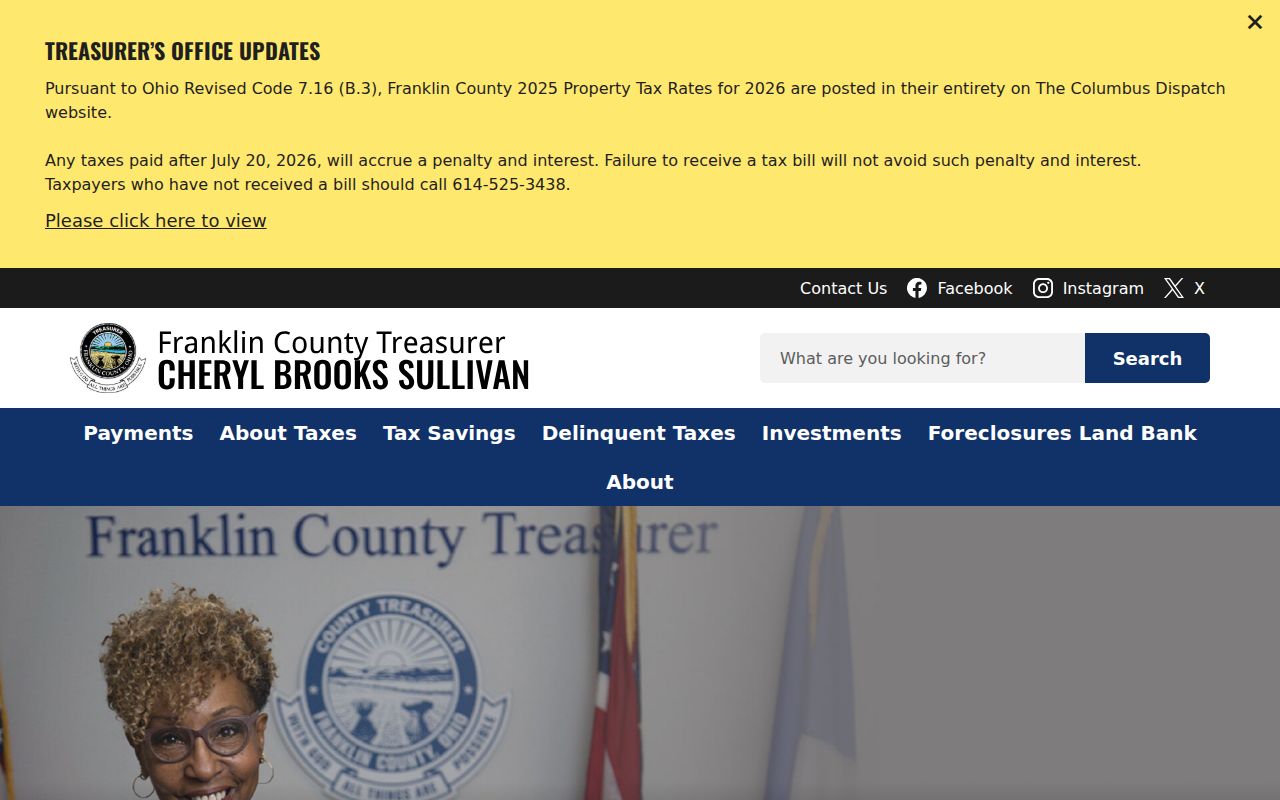
Tax information can help anchor a parcel to a particular year. It does not establish that every person connected with the parcel lived there.
Note: Capture the parcel ID and legal description before relying on an old street number or a mailing-city label.
Trace Norwich Township Previous Residents Through Deeds
The backward route is exact: current parcel, then legal description, then Recorder document, then the grantor as an earlier grantee, then the historical index. This order avoids a common error. Franklin County deeds may use a lot, subdivision, acreage, metes-and-bounds description, or predecessor parcel rather than a modern house number. The Recorder’s free public-search page presents cloud and legacy routes, and registration is optional for a search. A document image, not a name-only hit, must confirm that the land identity is the same.
- Find the current parcel and owner record in the Auditor search, and write down the legal description, lot, subdivision, or parcel clues.
- Locate the current owner’s acquisition document through the Franklin County Recorder Public Records Search.
- Compare the parties, recording or instrument reference, document date, and legal description with the parcel record.
- Search the seller, the grantor, as a grantee to identify that person’s earlier acquisition of the same land.
- Repeat the comparison for each earlier transfer. When the modern index ends, switch methods to the historic grantor and grantee indexes.
- Grantor and grantee
- The grantor transfers an interest in the document. The grantee receives that interest. In a backward title trail, the prior seller becomes the next name to investigate.
- Chain of title
- A documented succession of recorded instruments connected to the same parcel or legal description.
- Legal description
- The land-identifying language in a deed, such as a lot, subdivision, acreage, or metes-and-bounds description. It is more durable than a street address for older research.
The Recorder counter, telephone, and email channels are useful when a particular recorded document or historic index needs help. A narrow Ohio Public Records Act request under ORC 149.43 may seek an existing record, index entry, or copy. It does not require the office to create a list of past residents.
The Recorder cloud document search provides the current online document-search interface for the Norwich Township address trail.
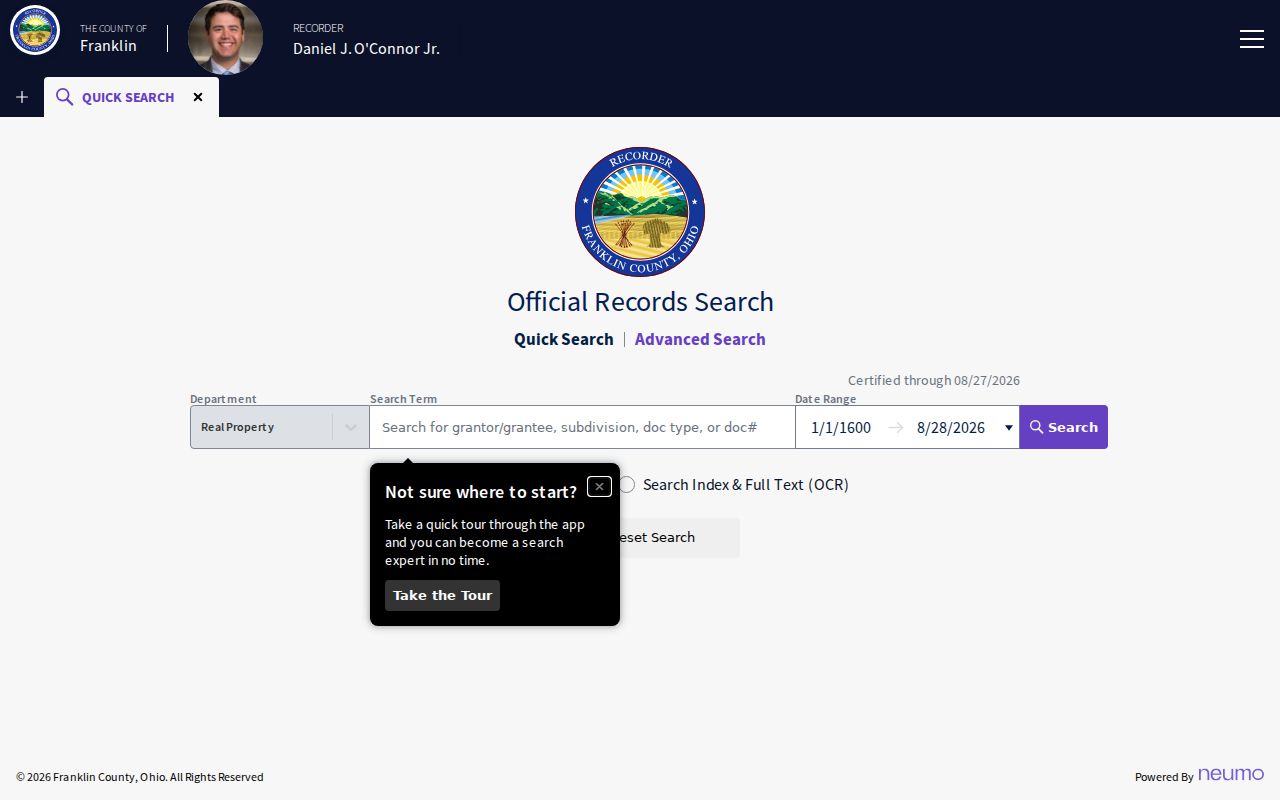
The online result is a starting point. Read the document image and legal description before carrying a party name into the next step.
Norwich Township Previous Residents Before 1914
For deeds before January 2, 1914, the Recorder’s historical search route is the handoff from the modern index. Its archive materials direct researchers to named historic index series for 1804 through 1913, including a Grantee Deed Index for 1804-1888. These are index and search boundaries, not a guarantee that every recorded document is equally easy to locate. Work from the confirmed legal description, book and page, or instrument information whenever possible.
The 1879 Franklin County fire requires a careful reading of silence in an early trail. Some records were destroyed, but most were reconstructed. That means neither that all early records disappeared nor that every surviving index is complete. Compare the historic entry and image with Probate, tax or plat material, a directory, and local newspapers before describing a gap as a change in ownership or household.
The Franklin County Recorder office is the historical-records contact for the legacy and counter route.
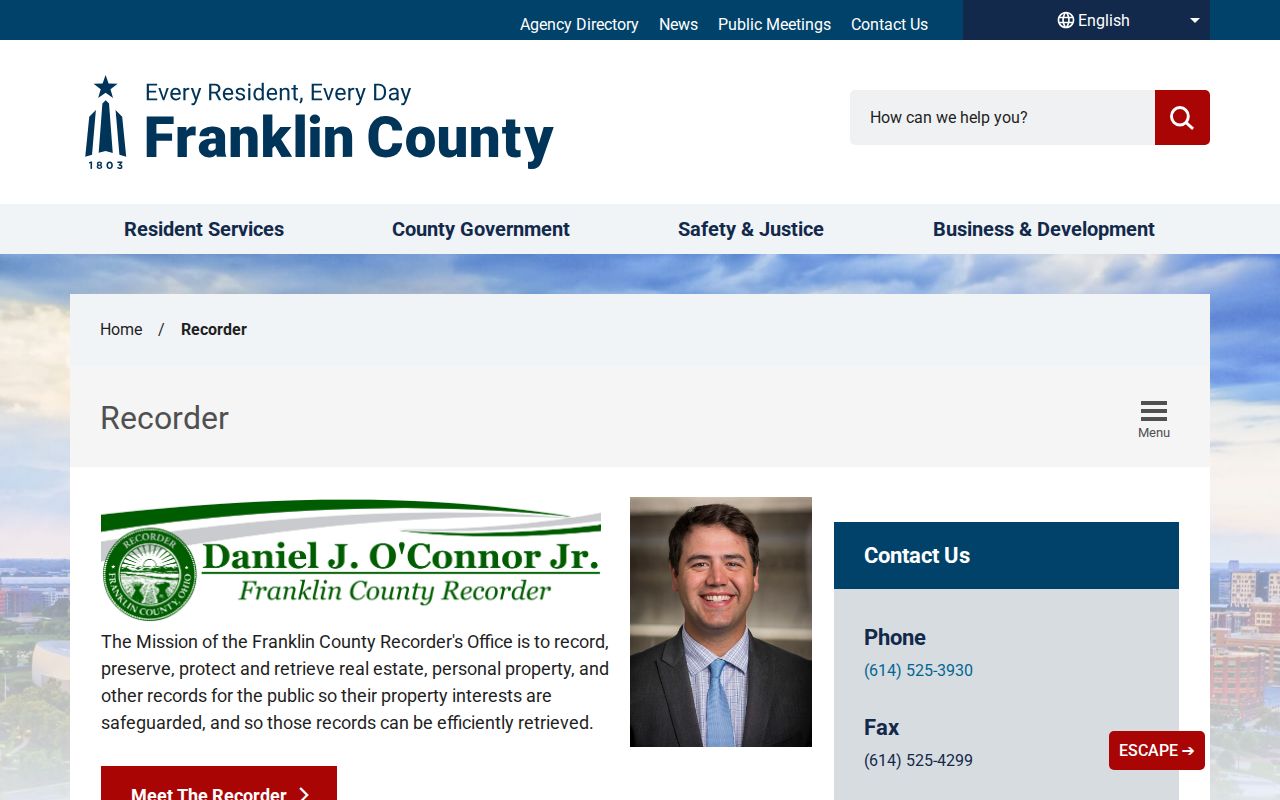
For a document question, the Recorder lists its office at 373 S. High Street, 18th Floor, in Columbus, with phone and email contact as alternatives to the web search. Ask about a specific deed, index range, volume, or copy rather than an open-ended person search.
Norwich Township Previous Residents in Directory Years
Deeds identify recorded parties. They do not necessarily tell who occupied an address between transfers. Columbus Metropolitan Library directories reach back to 1841, and their street-by-address section begins in 1911. Use a directory to place a listed occupant or household at an address for one edition year, while preserving the library’s warning that an occupant is not necessarily the owner. The collections themselves, digitized gaps and shelf access are detailed in the Norwich Township Directory Book.
Pair a directory year with the nearest released federal census through 1950. The census is a household snapshot on its enumeration date; a directory reflects its publisher’s compilation. Different results can signal a move, an address-number change, a spelling variant, a coverage limit, or a timing difference. They are not automatic proof that either source is wrong.
- Record the directory title, year, printed name, address form, and any clearly labeled detail.
- For 1911 or later, compare the street-by-address listing with the alphabetical entry.
- Locate the closest released census using the National Archives census research route and verify its enumeration geography.
- Return to the deed chain to separate a listed occupant from a recorded owner.
- Use Probate, obituary, or cemetery evidence as a dated endpoint or corroborating lead.
Hilliard-area materials offer useful in-between periods: a 1936 Franklin County phone book, a 1944 Columbus telephone directory, Hilliards Times from 1927-1934, and Hilliard Weekly Review from 1961-1964. They need the same address, date, and source checks as any directory entry.
Norwich Township Previous Residents and Sanborn Maps
A house-history search needs a building check as well as a name check. The Library’s guide directs researchers to Auditor data first, then directories, then historic real-estate and insurance maps. It lists Columbus Sanborn Insurance Maps for 1887, 1891, 1901, 1921, and 1921-51, online and on Main Library microfilm for all listed years, with hard copy for 1921-51. These maps can show a building outline or physical change, not the identity of a resident.
Verify that the historic Norwich Township location falls inside the particular Columbus map’s coverage before using it. The guide also cautions that Auditor “Year Built” dates before 1920 are often guesses and can be wrong. Legal description, plat, map, and directory evidence should agree before a researcher says an old structure and a modern address are the same property.
Note: A map can corroborate building continuity, but it cannot convert an annual directory listing into proof of ownership.
Norwich Township Previous Residents at Probate Endpoints
Probate and cemetery material can close a Norwich Township address trail without creating a complete account of a family. Franklin County Probate Court reports marriage records from 1803 to the present and estate, guardianship, and name-change records from 1898 to the present. Older material may be paper, microfilm, microfiche, or electronic depending on age. The court provides online, mail, email, and counter channels for its different record and copy processes. Restricted categories remain unavailable for public inspection.
Wesley Chapel Cemetery is a Township-linked genealogy resource with an official page and a linked burial search. The search offers name and date paths plus Cemetery, Block, Lot, and Grave tools. Its displayed result fields can include an interred name, dates, funeral home, location, age, sex, and veteran status; some records may show further details. No online start or end coverage year is published, so a missing result should not be read as proof that no burial record exists.
The Wesley Chapel burial search is the online lead route for this historical endpoint.
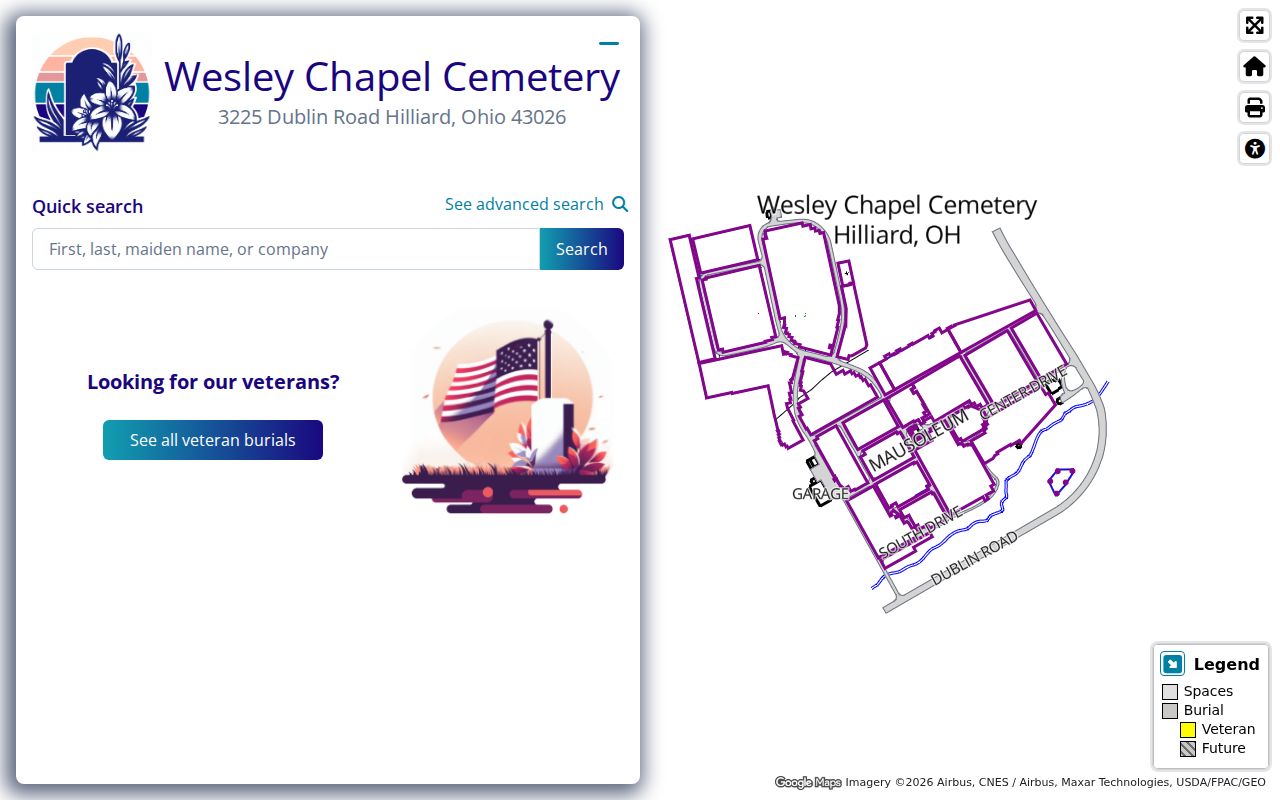
The Township cemetery office and the Probate Court are the appropriate follow-up channels for a specific historic record or copy question. A family plot can corroborate a date and relationship lead, but it does not prove that a person lived at one address for an entire period.
Norwich Township Previous Residents with Care
Past-resident research is best kept to house history, family history, estate questions, and personal reconnection. Public sources retain boundaries. A parcel owner, a recorded party, a directory occupant, and a census household are different facts made at different times. Protected addresses and confidential records may not appear in a normal search, and a missing entry does not prove that a person was absent from the area.
Use records responsibly. Keep the work tied to the historical address and its source dates. Do not use an old address trail to track, contact, harass, or harm a living person.
When an online index stops, use the documented alternatives: the Recorder counter or historic-index assistance, Main Library self-serve volumes, Ohio History Connection archival research, Probate’s identified copy channels, or a focused request to the actual record custodian. Those paths preserve the difference between a historical clue and a verified record.